Filmmakers & screenwriters
Examine the relationship between screenplay and cinematic realization. Trace how character, action, image and sound contribute to a film’s dramatic development.
Film analysis software · In development
Kinoform is a unique film-analysis environment for understanding cinema as an integrated dramatic whole. Its working prototype uses AI to map a film’s structure across shots, scenes, sequences and acts, bringing images, screenplay, character psychology, dialogue and sound into a unified field of analysis.
Developed for filmmakers, screenwriters, composers, editors, scholars and educators studying how cinematic form organizes dramatic action.
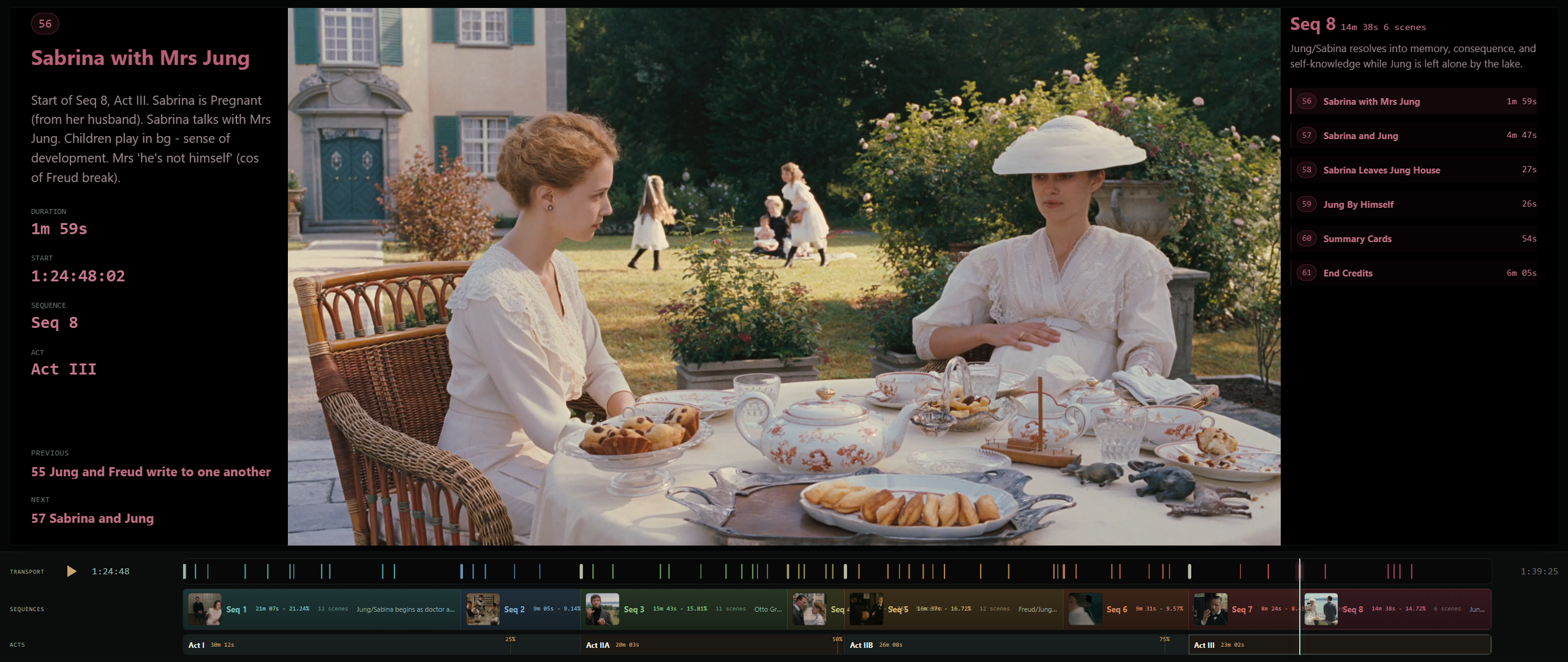
Working prototype · Structure workspace An analysis of A Dangerous Method, with scene notes, sequence navigation and a timeline linking the selected scene to the film’s dramatic structure.
View full-size screenshot01 / Approach
Follow a film from shot to scene, through sequences and across acts, to see how its meaning takes shape.
Conceptual diagram · 01
A human-led reading of the film
Film materials
The reading
Examine
and refine
Dramatic structure
Navigate a film’s scenes, sequences and acts alongside the playing image and soundtrack. Shot-cut markers provide precise anchors for examining and adjusting scene boundaries.
Inspect scene notes and analytical results, refine boundaries, and reorganize scenes and sequences. In studies with source evidence, boundary reviews also show support from screenplay, speech, sound and visual analysis.
Save a revised structure and export individual scenes as clips for closer examination, creative preparation, research or presentation.
Examine the relationship between screenplay and cinematic realization. Trace how character, action, image and sound contribute to a film’s dramatic development.
Study dramatic transitions and emotional development across scenes and sequences, supporting editorial analysis, scoring preparation and the selection of passages for closer study.
Navigate whole films at different structural scales and select passages for teaching or research into cinematic technique, dramatic form and psychological expression.
02 / Development
Kinoform aims to bring dramatic development and psychological interpretation into one reading. A character's inner life gives rise to dramatic action and to the images, sounds, rhythms and world through which that action becomes cinema. The project is being developed to follow these relations, with each interpretation answerable to the film’s evidence.
The proposed next phase would use Anthropic’s Claude models to investigate how motivations, emotional responses, conflicts and psychological development generate dramatic events.
In this future workflow, a filmmaker could select a scene and ask how a character’s emotional response generates the next dramatic action. Kinoform would propose an interpretation grounded in the available screenplay, dialogue, imagery, sound and structural evidence.
The filmmaker could compare that reading with the film, challenge its reasoning and refine the interpretation, then test it against the character’s development across subsequent scenes.
This is planned work. The interpretive engine is not part of the current prototype.
03 / About
Kinoform is an independent early-stage venture founded by Andrew Hewitt, a Los Angeles-based BAFTA-nominated composer for film and television, with work across international features and television productions.
He holds an MA in Music from the University of Cambridge and studied at the British Institute of Psychoanalysis. His experience in composition, filmmaking, film education, dramatic theory and psychological storytelling informs the project’s interest in how inner life becomes dramatic action.
Kinoform is being developed toward a professional release.
04 / Enquiries
For professional enquiries, development discussion and collaboration.